Imagine someone wants to find the best digital marketing course in Ahmedabad. They might search on Google, ask ChatGPT for recommendations or use an AI-powered search tool to compare different institutes. Although the goal is the same, the way they discover information can be different.
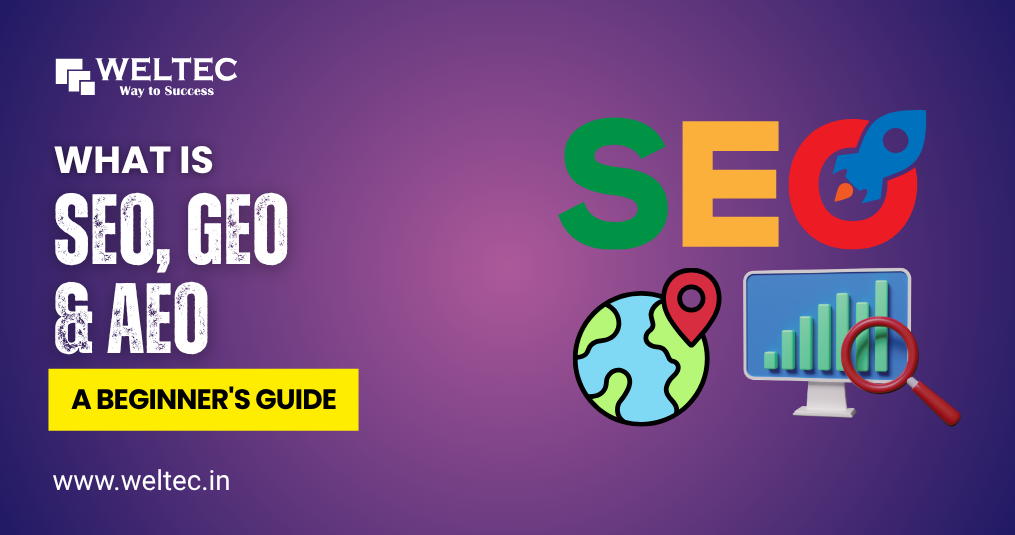
This change in search behaviour has brought three important terms into digital marketing: SEO, GEO and AEO. You may have already heard these terms in marketing discussions, blogs or online courses. They sound similar, but each highlights a different aspect of making your website and content easier to discover.
If you work in digital marketing or want to build a career in this field, understanding these concepts is becoming increasingly useful. Let’s explore what SEO, GEO and AEO mean, how they differ, and how you can use them together to improve your website’s visibility.
What Is SEO (Search Engine Optimisation)?
Search Engine Optimisation, commonly known as SEO, is the process of improving a website so that its pages can appear more prominently in organic search results. The objective is to help search engines understand your content and connect it with people searching for relevant information, products or services.
For example, suppose Weltec Institute wants its website to appear when someone searches for “Digital Marketing Course in Ahmedabad”. SEO involves improving the relevant course page, making sure search engines can access it, creating useful content and building the website’s credibility.
SEO includes several activities that work together:
- Keyword research: Understanding what people search for and identifying relevant keywords for your website.
- On-page SEO: Optimising page titles, headings, content, internal links and other page elements.
- Technical SEO: Improving crawling, indexing, website performance, mobile usability and site structure.
- Off-page SEO: Building website authority through relevant mentions, quality backlinks and other legitimate signals of credibility.
- Content optimisation: Publishing accurate, useful information that meets the needs of your target audience.
The main objective is not simply to rank for more keywords. It is to attract relevant visitors who are likely to find your content useful and take the next step, whether that means reading another article, enquiring about a course or purchasing a product.
What Is GEO (Generative Engine Optimisation)?
Generative Engine Optimisation, or GEO, refers to improving the chances of your content, business or brand being discovered, referenced or cited in AI-generated responses.
Traditional search engines commonly display a list of links for users to explore. Generative AI tools can go a step further by bringing information together from different sources and presenting a conversational response.
For example, someone might ask an AI search tool, “Which digital marketing institutes in Ahmedabad offer practical training and placement support?” Instead of looking through multiple search results, the person may receive a summary containing recommendations and supporting links.
GEO focuses on making your content useful and understandable for these generative search experiences. This can involve creating original, reliable information, explaining your expertise clearly and maintaining accurate details about your products or services across relevant online sources.
Some important GEO practices include:
- Create original content: Publish useful information, practical examples, expert insights and real experiences rather than simply repeating what other websites already say.
- Explain topics clearly: Use descriptive headings, specific examples and well-organised paragraphs so readers and search systems can understand the information.
- Build brand credibility: Maintain accurate business information and develop a trustworthy online presence through relevant, genuine mentions and references.
- Keep technical SEO strong: Ensure your pages can be crawled and indexed, and that important information is accessible to search systems.
- Answer related questions: Cover the useful details people need to make decisions, not just the main keyword they initially searched for.
It is important to understand that GEO does not guarantee that an AI tool will mention your business. AI-generated responses can vary depending on the query, the sources available and the system being used. Google also explains that established SEO practices remain relevant to its AI search experiences. Google’s guidance on AI search optimisation provides more detail.
What Is AEO (Answer Engine Optimisation)?
Answer Engine Optimisation, or AEO, focuses on making your content suitable for systems that provide direct answers to users’ questions.
Think about the last time you searched for something like “What is the ideal image size for an Instagram post?” You probably wanted a quick, clear answer rather than a long article that takes several minutes to read.
Answer-focused search features may display a short response, a featured snippet, a voice-assistant answer or information within an AI-powered interface. AEO aims to make your content clear, relevant and useful for these types of experiences.
To understand how it works, imagine you publish an article about keyword research. Instead of only discussing the topic broadly, you could include a clearly labelled section titled “What Is Keyword Research?” followed by a concise definition and a practical example.
This structure makes the answer easier for readers to find and can help search systems understand the purpose of that section. However, using a question as a heading does not guarantee that your content will appear as a featured snippet or AI answer.
Here are some useful AEO practices:
- Answer questions directly: Provide a clear response near the beginning of a relevant section before adding further explanation.
- Use question-based headings: Include genuine questions your audience is likely to ask.
- Organise information logically: Use descriptive headings, lists and tables when they make complex information easier to understand.
- Provide accurate details: Support factual claims with reliable sources and keep information up to date.
- Use structured data where appropriate: Implement relevant schema markup that accurately reflects the visible content on your page. Structured data can help search engines interpret information, but it does not guarantee a particular search appearance.
AEO is especially useful for informational content, FAQs, how-to guides and articles that address specific questions.
SEO vs GEO vs AEO: What Is the Difference?
Although the three approaches overlap, their main areas of emphasis are different.
| Factor | SEO | GEO | AEO |
| Full form | Search Engine Optimisation | Generative Engine Optimisation | Answer Engine Optimisation |
| Main focus | Organic search visibility | Visibility in generative AI responses | Visibility in direct answers |
| Common discovery experiences | Traditional search results | AI-generated summaries and recommendations | Featured snippets, answer boxes and voice responses |
| Content priority | Relevant, useful and discoverable pages | Original, credible and informative content that AI systems may reference | Clear, direct answers to specific questions |
| Example objective | Rank for a relevant course keyword | Get a course or brand referenced in an AI-generated recommendation | Provide a useful answer to a search question |
These are practical distinctions rather than completely separate disciplines. Their definitions can vary across the digital marketing industry, and some activities support all three.
For example, improving your website’s content quality, technical accessibility and credibility can benefit traditional search visibility as well as your chances of being referenced in AI-powered search experiences.
Do You Need SEO, GEO and AEO Separately?
Not necessarily. For most businesses, the sensible approach is to build a strong SEO foundation and incorporate GEO and AEO considerations into the same content strategy.
Consider a blog about choosing a Data Science course. You can optimise the page for relevant search terms, provide direct answers to common questions, explain course-selection criteria and include practical insights that distinguish your content from generic articles.
One well-planned article can therefore support several discovery methods without needing three separate versions of the same content.
Start by asking yourself three questions:
- SEO: Can search engines discover, crawl and understand this page, and does it address the reader’s search intent?
- GEO: Does the content provide useful, trustworthy information that could help an AI system answer a relevant question?
- AEO: Can readers quickly find a clear answer to the specific question they came to ask?
If your content addresses all three, you are taking a more complete approach to search visibility.
How to Optimise Your Website for SEO, GEO and AEO
You do not need to overhaul your entire website to get started. Begin with your important service pages and existing blog articles, then make improvements based on their purpose and performance.
1. Understand Your Audience’s Search Intent
Keyword research should go beyond collecting search terms. Understand why someone is searching and what information they expect to find.
For example, someone searching for “What is Data Analytics?” needs a basic explanation, while someone searching for “Data Analytics course fees in Ahmedabad” is likely comparing training options. Your content should reflect these different needs.
2. Create Useful, Original Content
Avoid publishing articles that simply repeat common definitions. Include examples, practical explanations, comparisons and insights based on genuine expertise. This gives readers a reason to choose your content over competing pages.
AI tools can help with research and drafting, but review the final content for accuracy, originality and usefulness. Publishing large amounts of repetitive material simply to target more keywords is not a sustainable strategy.
3. Structure Your Content Clearly
Use one clear H1 heading, descriptive H2 and H3 headings, readable paragraphs and lists where appropriate. Place direct answers near the relevant questions, then provide additional details for readers who want to explore the topic further.
This improves the reading experience and makes the page easier to navigate. It is not a special formula that guarantees AI citations or featured snippets.
4. Maintain Your Technical SEO
Make sure important pages can be crawled and indexed. Check for broken links, accidental indexing restrictions, poor mobile usability and unnecessary duplication. Use internal links to connect related articles and service pages.
Keep business information accurate, and ensure that important content is available in a form that search systems can access. Follow established technical SEO guidance rather than relying on unverified AI-specific tricks.
5. Measure Results and Improve
Use Google Search Console to monitor search impressions, clicks, click-through rates and average positions. Use Google Analytics to understand what visitors do after reaching your website, including whether they enquire about your services or complete another valuable action.
For AI visibility, you can also review relevant queries manually and monitor referral traffic and genuine brand mentions where possible. Measurement options differ between platforms, so do not rely on a single metric to judge your entire strategy.
Common Mistakes to Avoid When Using SEO, GEO and AEO
As these terms become more popular, marketers may feel pressured to adopt every new tactic they encounter. Some practices can waste time without improving the actual quality of a website.
Avoid these common mistakes:
- Treating keywords as the only priority: Content should answer the user’s needs rather than repeat a keyword unnecessarily.
- Writing only for AI systems: Your content still needs to be useful and readable for real people.
- Assuming schema guarantees visibility: Structured data can support search understanding, but it does not guarantee rankings, featured snippets or AI citations.
- Creating unnecessary content variations: Publishing several near-identical pages to target minor keyword differences can create a poor user experience.
- Believing in guaranteed AI rankings: No legitimate strategy can guarantee that every AI search tool will cite or recommend your business.
Google’s official guidance encourages website owners to focus on helpful, original content and established SEO fundamentals rather than relying on supposed GEO or AEO shortcuts. You can read more in its guide to optimising for generative AI features.
SEO, GEO and AEO are different but closely connected approaches to online visibility. SEO helps your website become discoverable through search engines, GEO focuses on visibility in generative AI experiences, and AEO emphasises providing clear answers to users’ questions.
For digital marketers, the priority should not be choosing one approach and ignoring the others. Build a technically sound website, understand your audience, publish original and trustworthy content, and make important information easy to find.
If you are learning digital marketing, start by practising keyword research, on-page SEO, content optimisation and technical SEO. Students enrolling in a Digital Marketing Course in Ahmedabad can also benefit from learning answer-focused writing and monitoring how content performs as search experiences evolve.
At Weltec Institute, learners exploring digital marketing can develop practical skills in SEO, content strategy and AI-assisted marketing workflows. By combining these skills with hands-on website optimisation projects, students can better understand how search visibility translates into meaningful business results.